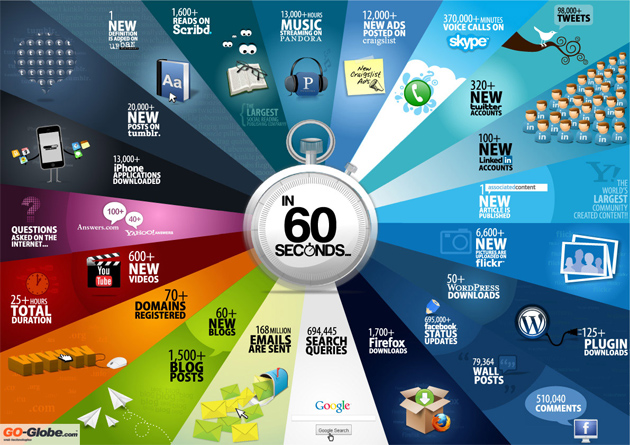
We can all agree that the Internet has become an essential part of our everyday lives. It’s where we work, where we play and how we stay in touch and share information with our family and friends. This infographic from GoGulf.com illustrates just how incredible the numbers are when you break them down to just 60 seconds.
For example, within in the last minute:
Can you imagine your daily life without the Internet?
According to numbers published by Royal Pingdom in 2009, the estimated number of emails sent per day was around 247 billion. Unfortunately 80% of those are thought to be spam and viruses. With junk and spam filters working overtime it’s no wonder people are finding alternatives to email when communicating with their friends, family and colleagues. Over the past decade widespread adoption of Instant Messaging and SMS has opened up alternative digital channels for people to send and receive quick messages and data.
More recently social media platforms have provided yet another viable alternative to email. Over 4 billion messages are sent through Facebook every day by 350,000 million of its 600,000 users. Twitter recently topped over 50 million tweets sent per day, which certainly must include thousands of Direct Messages between users.
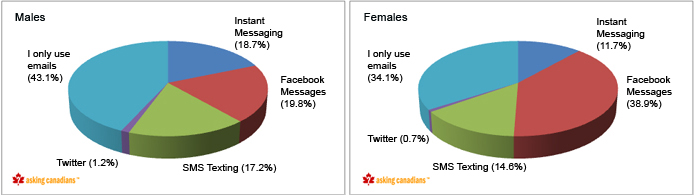
In a recent poll of 1000 members of our AskingCanadians™ panel we asked, “Which of the following applications do you most often use instead of email?”

SOURCE: AskingCanadians™
It came as no surprise that we saw that Facebook at 27.6 percent was the most popular alternative to email. SMS Texting was next at 16.2 percent, Instant Messaging was third with 15.9 percent and well behind at 1 percent was Twitter. When we broke the results out by gender it became evident that woman are using Facebook much more than men as an alternative to email by nearly 20%. It also appears that more men have been slower to abandon email (43.1 percent hanging on vs 34.1 percent of women) and instant messaging (18.7 percent usage vs 11.7 percent of women).
Smartphone users accessing their social media platforms has increased by more than 8.3 percent over the previous year and now stands at 30.8%. In fact access to Facebook via mobile browsers grew 112 percent and Twitter grew by a staggering 347 percent. Based on this increased usage of mobile to access and send messages through social media platforms, we can surely expect to see email usage shrink even more in the coming years.
In a recently released Neilson Co. report of online activity, Americans are spending nearly a quarter (22.7%) of their time on social network sites or blogs, and increase of 43% over June of 2009. Online games were up 10% to take over from Email as the second most popular online activity. Email took the biggest hit dropping 28% to third, no doubt cannibalized by the large increases in activity on Social Networks and Online Games. Messages that have been traditionally sent through email can now be easily sent quickly through Facebook, Twitter and other social networking sites. Another activity that may have suffered a significant hit from users increased time on Social Networks was Instant Messaging, dropping 15% from 2009.
Email is still the dominant activity on mobile devices, up from 37 per cent to nearly 42% of time. But Social Networking is experiencing growth even on mobile, up 28 per cent from last year. Other activities that have increased on mobile are video and gaming both seeing increases of nearly 20%. This could be tied to the increase of smartphone ownership, which allow for more complex activities.
Take this as a lesson folks; think twice before hitting send. No matter the subject or the audience, even the most heartfelt and well-intentioned emails can get you into trouble. And no, pleading ignorance won’t necessarily diffuse the situation. Onto the email that turned an Oscar invitation into a ticking time bomb… First-time Oscar-nominated producer [...]
Privacy Policy | © Copyright 2012 Delvinia