Skip to Main Content
 
Home
 

Engaging Viewers Through Social Television

July 26, 2011 | Posted by: connie | delvinia,Digital Culture,Featured Story,Social Media,Technology
 

Chances are your attention is focused on more than one screen when you’re watching television in your living room. By using your laptop, tablet or smartphone while watching TV, you are actually enhancing and socializing your experience during a broadcast.

Social television used to be about watching a television show and waiting until the next day to talk about it with your co-workers and friends. Today, social television revolves around mobile apps, social media sites like Facebook and Twitter, mobile TV and advertisements.

Last week, Randy Matheson and I led a Lunch & Learn for the Delvinia and AskingCanadians™ teams to talk about the shift in consumer behaviour and the trends that are emerging in social TV.

The idea of being interactive and social started more than a decade ago with the debut of shows like American Idol, a live reality show that encouraged viewers to vote via text message or phone. Today, American Idol has opened up its voting options by allowing viewers to vote on Facebook—for free. This demonstrates how social television has become an essential part of the viewer experience. And, being part of that experience makes it more appealing to watch live.

When you look at recent live events that have tied in social media, the statistics surrounding viewer participation have increased significantly. For example, during the live broadcast of the 2009 inauguration of Barack Obama, CNN created a Facebook integrated status update next to the live video stream on its website, resulting in more than 600,000 status updates by the end of the broadcast. The inauguration was streamed to 5.3 million viewers, setting a record for the network.

Fast forward to 2011 and the royal wedding, which sparked more than 2.7 million social mentions, with 94.7 per cent coming from Twitter. At one point during the April 29 event, live streaming peaked at 1.3 million. Statistics like this provide great insight to companies that want to use social television to engage viewers.

Television series such as Glee encourage fans to continuously use the hashtag #glee while watching the show live. Glee cast members also tweet to their fans during the show, driving the conversation levels up by 300 per cent.

Because of social television, networks and companies are also extending their websites and shows to become more compatible with mobile devices, which makes the two screen experience even better.


Incredible Numbers from 60 Seconds of the Internet
June 21, 2011 | Posted by: Randy Matheson | Digital Culture,Featured Story,Social Media
 

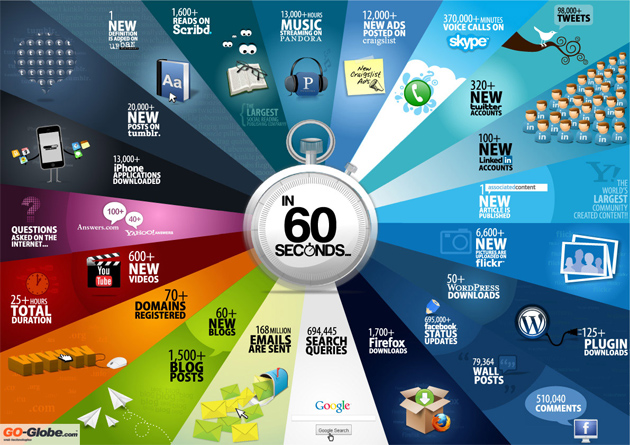
We can all agree that the Internet has become an essential part of our everyday lives. It’s where we work, where we play and how we stay in touch and share information with our family and friends. This infographic from GoGulf.com illustrates just how incredible the numbers are when you break them down to just 60 seconds.

In One Minute on the Internet


For example, within in the last minute:

  • 600 new videos were added to YouTube
  • 13,000+ iPhone applications were downloaded
  • 20,000+ news posts were added to Tumblr
  • 98,000 new Tweets were posted
  • 6,600+ news pictures were uploaded to Flickr
  • 695,000+ Facebook status updates were added
    • Can you imagine your daily life without the Internet?

      Image Source


    The New Information Organization Paradigm – People as the Filter
    May 17, 2011 | Posted by: Rosalina Lin-Allen | delvinia,Digital Culture,Social Media
     

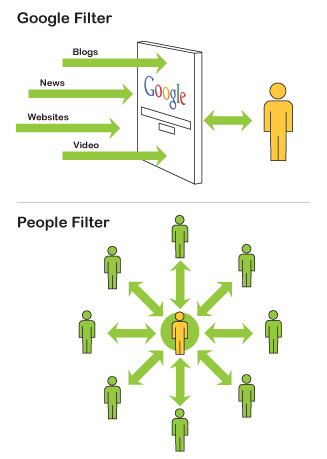
    Google vs People FilterFor a good decade, Google has been the king of the Internet. The search engine organizes content based on data such as keywords, links, etc. However, in March 2010, Facebook traffic surpassed that of Google and Facebook continues to grow rapidly with no sign of slowing down. How did Facebook become so important? Will its dominance prevail?

    I believe the answer is yes (provided they don’t screw up on execution) but not because the social media network allows people to connect and stay connected. I believe Facebook has found a different paradigm to organize content on the Internet—by using people as filters, as opposed to Google’s approach where data is the filter.

    With an overwhelming amount of content and diminishing trust towards corporations, people increasingly rely on their friends and families to filter information. The popularity of customer ratings and reviews illustrates this fact.

    While many of the exchanges on Facebook are still personal interactions, Facebook is inching towards the vision of organizing content on the Internet in a new way. From the very early features such as Facebook News Feed to Facebook OAuth (formerly known as Connect) and the failed Facebook Beacon feature (that shared out what your friends purchased), Facebook has been moving its users slowly but surely towards information organized through people.

    Such paradigms are increasingly popular. Twitter—the other powerhouse in the social media space—is also wildly successful for the very same reason. People are connected to pertinent information based on who they follow. Flipboard, a top iPad app, took things one step further. Similar to Twitter, the app leverages people in your network to point you to what information to pay attention to. But instead of displaying it in 140 characters of text, the app displays content in a beautiful magazine format, catered just to you.

    Having said all this, it begs the question whether Google will become obsolete. My prediction is no. When the television rose in popularity, it didn’t replace print as some had predicted and when the Internet rose up, it didn’t replace television. Different solutions have their own pros and cons. In the end, they have all found their own place in the user’s ecosystem.


    May 16, 2011 | Posted by: Rosalina Lin-Allen | delvinia,Digital Culture,Social Media,Technology
     

    Derek Miller’s “The Last Post” was published on his blog penmachine.com by a friend on May 4, a day after the 41-year-old father of two died from complications of colorectal cancer in Burnaby, B.C. His last post went viral drawing millions of views from around the world. Many of us don’t think much about our [...]


    March 29, 2011 | Posted by: Susan O'Neill | delvinia,Featured Story,Press release,Projects,Social Media,Work
     

    Delvinia’s DIY Markham campaign, created to raise awareness of the 2010 municipal election in the Town of Markham and to increase citizen engagement in the municipality, has been recognized with an award for Best Government Online Video in the Web Marketing Association’s 2011 Internet Advertising Competition. The social media awareness campaign, designed and implemented by [...]


    March 4, 2011 | Posted by: Katy Pedersen | Digital Culture,Social Media
     

    This subject has been beaten to death, but clearly we’re not learning our lesson. When it comes to smartphone etiquette, we’re becoming a society of rude dudes (and dudettes). I recently had the pleasure of hearing Wendy Harmon speak about the efforts the American Red Cross made in the wake of the Haiti Earthquake at [...]


    March 3, 2011 | Posted by: Randy Matheson | Social Media,Technology
     

    As long as I can remember I have always been a news addict. A habit that has been passed down from my father back in Nova Scotia. An early picture even shows me struggling to open a copy of Sports Illustrated. I would read the local newspapers front to back, gobble up every news magazine [...]


    February 14, 2011 | Posted by: Randy Matheson | Digital Culture,Featured Story,Social Media
     

    Honestly I had no idea that these two icons had even broken up. It turns out however, that Ken Carson and Barbie Roberts (yes, they have last names) have been an on-and-off thing since they first met in 1961. Apparently all was not well at the Barbie dream house. In fact, in 2004 Mattel issued [...]


    February 11, 2011 | Posted by: Susan O'Neill | delvinia,Featured Story,Press release,Social Media
     

    When it comes to using digital technology to promote elections and engage citizens with government, there are few organizations that understand the process as well as Delvinia. Since 2003, Devlinia has been involved in a partnership with the Town of Markham to help the municipality better communicate the importance of voting at the municipal level. [...]


    December 20, 2010 | Posted by: Delvinia | Link Pool
     

    Security Guru Launches iPhone App To Hack Colorblindness Forbes How Much Is a Tweet Worth? $500, Says Toyota Mashable Smart Pink: Effective breast cancer self diagnosis kit GizmoDiva.com W3C releases Mobile Web Application Best Practices guidelines Gizmag Mobile Future: Mobile Year in Review 2010 Video Mobile Future Click here to see what links we’re sharing [...]


    Older Posts »